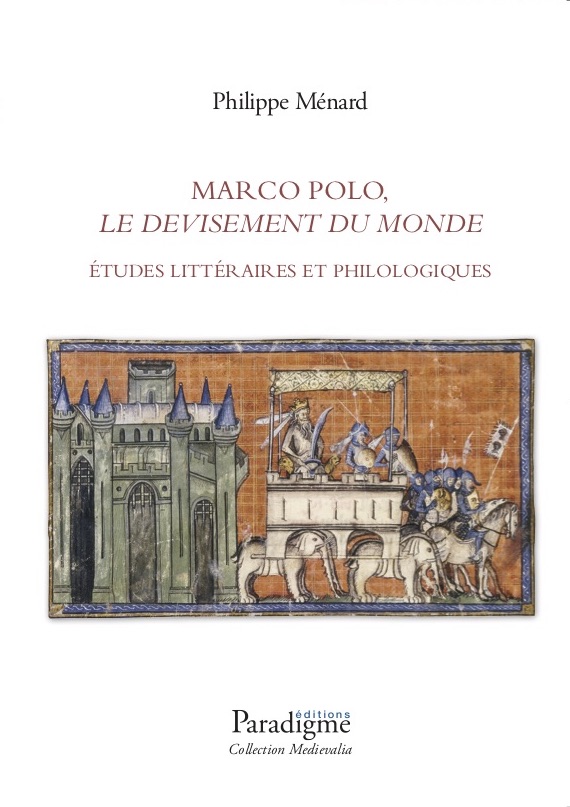

Philippe Ménard, Marco Polo, “Le devisement du monde”: Études littéraires et
philologiques. (Collana Medievalia.) Orléans: Paradigme, 2023. Paper. Pp. 466; color
and black-and-white figures. €34. ISBN: 978-2-8687-8532-9.
Philippe Ménard’s 2023 volume, published on the eve of the seventh centenary of Marco Polo’s
death (1324–2024), offers a synthesis of nearly forty years of research on the Devisement du
monde (DdM) and its complex textual tradition. Ménard integrates philological, linguistic,
narratological, cultural, and historical approaches. The result, marked by clearly defined posi-
tions, constitutes an authoritative contribution to Marco Polo studies. The volume includes
both color and black-and-white illustrations and concludes with a bibliography and indexes of
manuscripts, cited works, and thematic subjects.
The introduction and fifteen essays—two previously unpublished and the others revised for
this volume—outline Ménard’s principal research areas, centered on recurring themes pivotal
to his work. The first major topic, concerning the “original version” of the DdM, is introduced
in the opening essay, which situates Marco Polo’s life, journey, and book; it is then revisited in
essays 2, 3, and most extensively in essay 4. In a critique of Luigi Foscolo Benedetto’s landmark
edition (1928), Ménard denies the possibility of recovering “une seule version originale” [a sin-
gle original version] (136), citing both the extreme mouvance of the tradition and the work’s
composition through multiple phases of rewriting. This leads him to approach stemmatic
reconstruction with skepticism and to emphasize the independence of individual versions as
historical witnesses. While acknowledging Benedetto’s achievements, Ménard criticizes his
overvaluation of the Franco-Italian version F—of which the only complete witness is Paris,
Bibliothèque nationale de France, MS fr. 1116—and his reconstructive framework: “C’est
une illusion, une chimère” [It is an illusion, a chimera] (136).
A second issue, already implicit in the first, is the reassessment of the French version (Fr) of
the DdM. Published in six volumes under Ménard’s direction (2001–9), this version stands at
the center of essays 2, 4, 5, 8, 9, and 12. Essay 5, in particular, represents one of Ménard’s
most significant contributions: it demonstrates that Grégoire—whose name appears in onl two manuscripts and whom Benedetto had considered the redactor of Fr—is in fact merely a copyist. Ménard also questions Benedetto’s definition of “rimaneggiamento” [rewriting]
and emphasizes the merits of Fr, including its superior linguistic quality compared with BnF
fr. 1116, early dating (1310–12), substantial textual completeness, wide circulation (seventeen
witnesses), and aristocratic milieu of production and circulation. Essay 7 provides a parallel
analysis of Francesco Pipino’s Latin translation (P), which, shaped by a Christian perspective,
introduces adaptations into Polo’s text.
The volume then turns to essays in which narratological, linguistic, philological, and cultural
perspectives intersect. Though addressing different aspects of the DdM, these studies share the
aim of clarifying its composition, transmission, and reception mechanisms. Essays 8 and 9 probe
the text’s enunciative techniques. Essay 8 examines aspects of focalization, whereas essay 9
analyzes the distribution of references to Marco Polo across seven versions of his text. Essays 6
and 10–12 focus on linguistic and lexical issues: essay 6 considers instances of linguistic inter-
ference, while essay 10 lists and scrutinizes loanwords from Arabic and the languages of the
Mongol Empire. Essays 11 and 12, devoted to the French version, investigate nautical vocab-
ulary and Italianisms. Essays 13 and 14 are conceived as parallel studies, each focusing on a
fragment of the DdM—one Franco-Italian (F) and the other Anglo-Norman (X)—and
offering paleographic and linguistic analyses. The latter essay provides the only comprehensive
overview currently available of the Anglo-Norman witness. The concluding essay, assessing
Marco Polo’s contribution to Western culture, highlights the DdM’s importance as both a
source of knowledge and a foundational text in the shaping of European conceptions of Asia.
Overall, the volume conveys both the breadth and coherence of Ménard’s research, provid-
ing readers with useful tools alongside an interdisciplinary perspective on Marco Polo’s tex-
tual tradition. Because the volume brings together essays written between 1998 and 2017,
it understandably reflects a limited engagement with more recent scholarship. In particular,
it does not fully consider the ecdotic proposals of Italian scholars coordinated by Eugenio
Burgio, which reconcile a multiredactional hypothesis with a stemmatic framework; nor
does it substantially engage with Christine Gadrat-Ouerfelli’s work on the European reception
of the DdM, or—with respect to Asian studies—with contributions by Hans U. Vogel and
Stephen G. Haw. The decision to restrict the analysis to the seven “main” versions (F, Fr, TA,
VA, P, Z, and R) risks overlooking insights offered by other thirteenth- and fourteenth-century
versions (L, V, VB, K, TB) within a comparative framework. In certain instances, a synchronic
approach may obscure errors in textual transmission. The lemma rondes (250), for example,
is attested only in branch VA, whereas other versions, such as F, present the reading “le[s] roi
des pelames” [the king of furs]. Ménard regards rondes as the correct reading, identifying it
as a Mongol term for sable fur. However, as Valeria Bertolucci Pizzorusso has shown, an
analysis of the other versions suggests that rondes is likely a misreading of *roides (pelames).
This reading also appears in Ramusio’s printed edition via Pipino’s translation, based on VA.
These reservations notwithstanding, the volume remains an important reference work for
specialists in the DdM. At the same time, it provides an accessible introduction to the complex
textual tradition of Marco Polo, reflecting the breadth and originality of Ménard’s scholarship.
Samuela Simion, Università Ca’ Foscari Venezia